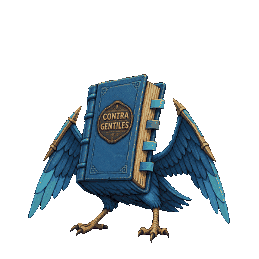
“…some of them, like the Mohammedans and pagans, do not agree with us as to the authority of any Scripture whereby they may be convinced, in the same way as we are able to dispute with the Jews by means of the Old Testament, and with heretics by means of the New: whereas the former accept neither. Wherefore it is necessary to have recourse to natural reason, to which all are compelled to assent.”
Aquinas, Summa Contra Gentiles 1.2 (trans. English Dominican Fathers, 1924, public domain). (trimmed quote)public domain
How it works in the game: the move No Shared Scripture
RationalityArgument · power 75 · 100% accurate
In the gameWork out what the other person actually grants before arguing. Where no book is held in common, the only ground left is reason — so start there.
Learned byContra Gentiles (Lv 1)
Strong against
×2.5The Triumph of the Crossa book · why?
Savonarola wrote the Triumph of the Cross to do for his age what Aquinas’s Contra Gentiles did for the Middle Ages. This is Aquinas’s own opening move.
×2.5The Two Truthsan argument · why?
No Scripture is held in common here — so Aquinas starts exactly where this debate actually is.
“The existence of God can be proved in five ways. The first and more manifest way is the argument from motion… it is necessary to arrive at a first mover, put in motion by no other; and this everyone understands to be God.”
Aquinas, Summa Theologiae I, q.2, a.3 (trans. English Dominican Fathers, public domain). (trimmed quote)public domain
“There is no case known… in which a thing is found to be the efficient cause of itself… Therefore it is necessary to admit a first efficient cause, to which everyone gives the name of God.”
Aquinas, Summa Theologiae I, q.2, a.3, the second way (trans. English Dominican Fathers, public domain). (trimmed quote)public domain
“Therefore we cannot but postulate the existence of some being having of itself its own necessity, and not receiving it from another… This all men speak of as God.”
Aquinas, Summa Theologiae I, q.2, a.3, the third way, from contingency (trans. English Dominican Fathers, public domain). (trimmed quote)public domain
How it works in the game: the move The Five Ways
Natural TheologyArgument · power 78 · 100% accurate
In the gameFive arguments that start from things anyone can see — motion, cause, contingency — and walk to the same place. The move draws one of them.
Learned byContra Gentiles (Lv 39), Summa Theologiae (Lv 1)
Strong against
×3Why I Am Not a Christianan argument · why?
Russell attacks "everything must have a cause." Aquinas never wrote that. The Second Way is that nothing can be the efficient cause of itself — a different claim, and the one he walked past. The reader carried the real arguments out of the Philosopher’s Hall.
×2The Possible and the Necessaryan argument · why?
Aquinas builds the same argument from possibility and necessity — and then spends the rest of the book arguing that what it arrives at is one, simple, good, and provident, which is most of the way to the God actually worshiped.
×2The Two Truthsan argument · why?
Aquinas held that faith and reason cannot truly contradict, because God is the source of both. His Five Ways reach God by reason alone, with no need for a second truth.
“The first and more manifest way is the argument from motion. It is certain, and evident to our senses, that in the world some things are in motion. Now whatever is in motion is put in motion by another… it is necessary to arrive at a first mover, put in motion by no other; and this everyone understands to be God.”
Aquinas, Summa Theologiae I, q.2, a.3 (trans. English Dominican Fathers, public domain). (trimmed quote)public domain
How it works in the game: the move The First Way: Motion
Natural TheologyArgument · power 74 · 100% accurate
In the gameThings move. Nothing moves itself, and the chain of movers cannot run back for ever. Aquinas takes this one from Aristotle and says so.
Learned byThomas’ Corpus (Lv 29)
“There is no case known (neither is it, indeed, possible) in which a thing is found to be the efficient cause of itself; for so it would be prior to itself, which is impossible… Therefore it is necessary to admit a first efficient cause, to which everyone gives the name of God.”
Aquinas, Summa Theologiae I, q.2, a.3, the second way (trans. English Dominican Fathers, public domain). (trimmed quote)public domain
How it works in the game: the move The Second Way: Cause
Natural TheologyArgument · power 74 · 100% accurate
In the gameNothing causes itself, because it would have to exist before it existed. Take away the first cause and you take away everything after it.
Learned byThomas’ Corpus (Lv 30)
“We find in nature things that are possible to be and not to be… Therefore, if everything is possible not to be, then at one time there could have been nothing in existence… Therefore we cannot but postulate the existence of some being having of itself its own necessity… This all men speak of as God.”
Aquinas, Summa Theologiae I, q.2, a.3, the third way (trans. English Dominican Fathers, public domain). (trimmed quote)public domain
How it works in the game: the move The Third Way: Contingency
Natural TheologyArgument · power 76 · 100% accurate
In the gameEverything around us might not have been. If everything were like that, at some point there would have been nothing — and nothing comes from nothing.
Learned byThomas’ Corpus (Lv 31)
“Among beings there are some more and some less good, true, noble and the like. But “more” and “less” are predicated of different things, according as they resemble in their different ways something which is the maximum… Therefore there must also be something which is to all beings the cause of their being, goodness, and every other perfection; and this we call God.”
Aquinas, Summa Theologiae I, q.2, a.3, the fourth way (trans. English Dominican Fathers, public domain). (trimmed quote)public domain
How it works in the game: the move The Fourth Way: Gradation
Natural TheologyArgument · power 72 · 100% accurate
In the gameWe rank things — better, truer, nobler. A comparison needs something to compare against, and the maximum in any kind is the cause of the rest.
Learned byThomas’ Corpus (Lv 32)
“Since therefore grace does not destroy nature but perfects it, natural reason should minister to faith as the natural bent of the will ministers to charity.”
Aquinas, Summa Theologiae I, q.1, a.8 (trans. English Dominican Fathers, public domain). Close to a thesis statement for the whole faith-and-reason tradition.public domain
How it works in the game: the move Grace Perfects Nature
RationalityArgument · power 68 · 100% accurate
In the gameReason is not faith’s rival and not its replacement — it is the thing faith takes up and uses. The book’s own Defend may rise as it says so.
Learned byContra Gentiles (Lv 44), Summa Theologiae (Lv 40)
Strong against
×2.5Platoa book · why?
Nobody here says Plato was wrong. The claim is that he was unfinished, and that what he was reaching for came down and finished it.
“The author of Holy Writ is God, in whose power it is to signify His meaning, not by words only (as man also can do), but also by things themselves.”
Aquinas, Summa Theologiae I, q.1, a.10 (trans. English Dominican Fathers, public domain).public domain
How it works in the game: the move Master of the Sacred Page
ExegesisArgument · power 86 · 100% accurate
In the gameAquinas’ chair was a chair in Scripture, and lecturing on the Bible was the job. He worked through Job, Isaiah, Jeremiah, Lamentations, the Psalms, Matthew, John and every letter of Paul. The Summa was written round the edges of that, by a man whose title was Master of the Sacred Page.
Learned byThomas’ Corpus (Lv 40)
“Nor did he add any signs of supernatural agency, which alone are a fitting witness to divine inspiration… but he asserted that he was sent in the power of arms, a sign that is not lacking even to robbers and tyrants.”
Aquinas, Summa Contra Gentiles 1.6 (trans. English Dominican Fathers, 1924, public domain). (trimmed quote.) Written to train Dominican missionaries, and far harsher than Timothy I of Baghdad was in 781 — compare Signs and Miracles.public domain
“Hence by a cunning device, he did not commit the reading of the Old and New Testament Books to his followers, lest he should thereby be convicted of falsehood.”
Aquinas, Summa Contra Gentiles 1.6 (trans. English Dominican Fathers, 1924, public domain). The charge is that the claim was kept away from the documents that would test it — which is the one habit this whole game is built on.public domain
How it works in the game: the move Sent in the Power of Arms
HistoryArgument · power 72 · 100% accurate
In the gameAsk what attested the claim. Aquinas has just argued that the faith spread while promising its converts nothing but hardship, and sets the comparison against that.
Learned byContra Gentiles (Lv 42)
Strong against
×2The Triumph of the Crossa book · why?
Savonarola followed the plan of Aquinas’s Contra Gentiles, and this is one of its arguments.
“…although the argument from authority based on human reason is the weakest, yet the argument from authority based on divine revelation is the strongest… properly uses the authority of the canonical Scriptures as an incontrovertible proof, and the authority of the doctors of the Church as one that may properly be used, yet merely as probable.”
Aquinas, Summa Theologiae I, q.1, a.8 (trans. English Dominican Fathers, public domain). (trimmed quote)public domain
How it works in the game: the move The Strongest Authority
BibleArgument · power 80 · 100% accurate
In the gameRank the authorities you both accept. An argument from human authority is the weakest there is; an argument from what God has revealed is the strongest. And the doctors of the church, Aquinas says in the same breath, are worth citing but only ever probable.
Learned byThomas’ Corpus (Lv 45)
“And indeed, we believe that thou art a being than which nothing greater can be conceived… But, at any rate, this very fool, when he hears of this being of which I speak… understands what he hears, and what he understands is in his understanding.”
Anselm, Proslogium 2 (trans. Sidney Norton Deane, 1903, public domain). (trimmed quote)public domain
How it works in the game: the move Than Which Nothing Greater
RationalityArgument · power 82 · 90% accurate
In the gameAddressed to the fool of Psalm 14, and it uses his own understanding against him: to deny the idea, he must first hold it. Expensive, and it does not always land.
Learned bySumma Theologiae (Lv 46)
Strong against
×0.5In Behalf of the Foolan argument · why?
It slides off. Getting from the understanding to the world is the very step he is refusing.
“…the will is made actual by the appetible object, which stills the movement of its desire. And the will’s desire is satisfied by the divine good alone as its last end.”
Aquinas, Summa Contra Gentiles 3.88 (trans. English Dominican Fathers, 1928, public domain). (trimmed quote)public domain
How it works in the game: the move Rest
SpiritualityRest · 100% accurate
In the gameBreak off and rest. Stamina is restored in full and any trouble is slept off, but the book is then ASLEEP for a turn (two turns, one time in five) while the other side does as it likes.
Learned byContra Gentiles (Lv 50)