
← All authors
c. A.D. 477 – 524

Boethius

Worth knowing

  • A Roman senator and consul who served the Gothic king Theodoric at Ravenna.
  • He translated Aristotle's books on logic into Latin. For six hundred years they were most of what the Latin West had of Aristotle.
  • His short theological treatises defined a person as "an individual substance of a rational nature", a definition theology still uses when it speaks of the Trinity and of Christ.
  • Accused of treason, he wrote The Consolation of Philosophy in prison and was executed in 524.

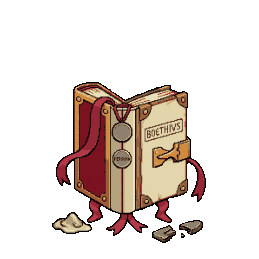
In Scholar’s Dream, Boethius has five books

Boethius’s quotes in the game

Every quotation from Boethius that a player meets in Scholar’s Dream, attached to the move that says it. Or see them as a plain list →

In Scholar’s Dream, books argue with each other, and each thing a book can do in a debate is called a move. Every quote below is spoken by one of those moves. Open “How it works in the game” under a quote to see the move, which books learn it, and which arguments it answers best.

“Then,” said she, “it is necessary to acknowledge that God is very happiness.” … “But we have also proved that God and true happiness are one and the same.”

Boethius, The Consolation of Philosophy III.10 (trans. H. R. James, 1897, public domain). (trimmed quote)public domain
How it works in the game: the move God Is Happiness
RationalityArgument · power 90 · 100% accurate

In the gameThe last link of a chain: the source of all good can have nothing better than itself, so it is the highest good — and the highest good has already been shown to be happiness. Therefore God does not HAVE happiness. He is it.

Learned byConsolation (Lv 1)

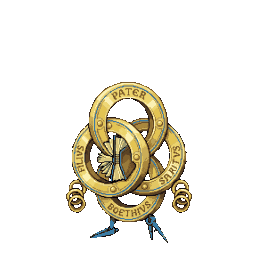
“So then, the category of substance preserves the Unity, that of relation brings about the Trinity.”

Boethius, De Trinitate (trans. H. F. Stewart & E. K. Rand, Loeb Classical Library 1918, public domain).public domain
How it works in the game: the move Only by Relation
Theology ProperArgument · power 90 · 100% accurate

In the gameSay “the Father is God, the Son is God, the Spirit is God” and you have said one thing three times, not counted to three. What tells the persons apart is relation — and a relation divides no substance.

Learned byDe Trinitate (Lv 1), Boethius’ Corpus (Lv 40)

Strong against
×2"That’s Three Gods"an argument · why?

Boethius explained it: what they are keeps them one, and how they relate makes them three. Father, Son and Spirit differ only in their relations to each other.

“Thus Nestorius, rightly holding Christ’s Nature to be double, sacrilegiously professes the Persons to be two; whereas Eutyches, rightly believing the Person to be single, impiously believes that the Nature also is single.”

Boethius, Contra Eutychen et Nestorium 5 (trans. Stewart & Rand, Loeb 1918, public domain).public domain
How it works in the game: the move Opposite Errors, One Mistake
ChristologyArgument · power 88 · 100% accurate

In the gameNestorius and Eutyches fell off the same road on opposite sides — one made two Persons to keep the two natures, the other collapsed the natures to keep the one Person. Both thought a nature and a person had to be counted together. Neither does.

Learned byContra Eutychen (Lv 1)

“we have found the definition of Person, viz.: ‘The individual substance of a rational nature.’”

Boethius, Contra Eutychen et Nestorium III (trans. Stewart & Rand, Loeb 1918, public domain). Latin: naturae rationabilis individua substantia.public domain
How it works in the game: the move An Individual Substance
ChristologyArgument · power 85 · 100% accurate

In the gameThe sentence every later argument about Christ — and, centuries on, every argument about what a person even is — was built from. Boethius pins it: a person is one particular thing, and a rational one.

Learned byContra Eutychen (Lv 24), Boethius’ Corpus (Lv 43)

Strong against
×2.5Summa Theologiaea book · why?

Aquinas takes Boethius’s definition of a person and defends it (Summa I, q.29, a.1).

“the Divine Substance is Form without matter, and is therefore One, and is its own essence.”

Boethius, De Trinitate 2 (trans. H. F. Stewart & E. K. Rand, Loeb Classical Library 1918, public domain).public domain
How it works in the game: the move Form Without Matter
Natural TheologyArgument · power 80 · 100% accurate

In the gameA statue is a statue by its form, not its bronze; earth is earth by dryness and weight, not by bare stuff. Follow that up: the one thing with no matter under it at all is not made of anything. It simply IS what it is.

Learned byDe Trinitate (Lv 24)

“Diversity repels; likeness attracts. That which seeks something outside itself is demonstrably of the same nature as that which it seeks.”

Boethius, Quomodo substantiae (the Hebdomads), rule IX (trans. H. F. Stewart & E. K. Rand, Loeb Classical Library 1918, public domain).public domain
How it works in the game: the move Likeness Attracts
RationalityArgument · power 76 · 100% accurate

In the gameBoethius sets out nine rules before he argues, like a geometer stating axioms. The ninth says that like is drawn to like. What a creature reaches for tells you what it is made for.

Learned byBoethius’ Corpus (Lv 28)

“among followers of the true Faith He is equally believed to be of two natures and in two natures.”

Boethius, Contra Eutychen et Nestorium, preface (trans. Stewart & Rand, Loeb 1918, public domain).public domain
How it works in the game: the move Of and In Two Natures
ChristologyArgument · power 82 · 100% accurate

In the gameThe Eutychians would say Christ was formed FROM two natures and leave it there — one nature after. The catholic keeps both prepositions: of two natures, and still in two natures, after the union as before it.

Learned byContra Eutychen (Lv 30)

“…is not a happy life what all will, and no one altogether wills it not?… And this is the happy life, to rejoice to Thee, of Thee, for Thee; this is it, and there is no other.”

Augustine, Confessions 10.20–23 (trans. E. B. Pusey, 1838, public domain).public domain

“the desire of the true good is naturally implanted in the minds of men; only error leads them aside out of the way in pursuit of the false.”

Boethius, The Consolation of Philosophy III.2 (trans. H. R. James, 1897, public domain).public domain
How it works in the game: the move Argument from Desire
Natural TheologyArgument · power 74 · 100% accurate

In the gameNobody has to be taught to want to be happy, and nothing on offer finishes the wanting. Augustine and Boethius, a century apart, both take the permanent hunger as evidence of where the food is.

Learned byConsolation (Lv 32)

Strong against
×4The Absurdan argument · why?

Camus grants the hunger and the silence, and calls their collision the absurd. Augustine and Lewis take the same hunger the other way. A hunger for something the world cannot supply is one of the ordinary signs that something else supplies it. Camus wrote his university thesis on Augustine.

×4Totem and Tabooan argument · why?

Freud explains where the longing came from. He never asks the other question — whether a longing this specific, appearing in every culture, is evidence that it has an object.

×2.5Platoa book · why?

Diotima’s ladder in the Symposium climbs from one beautiful body to all of them to beauty itself, because no particular thing ever finishes the wanting. Augustine makes that argument nearly eight centuries later and grants Plato every rung of it. What a Form cannot do is come looking for you.

×2Grace as Examplean argument · why?

Augustine found that nothing he chose could satisfy him until God changed what he loved. Grace did not only teach him. It changed his heart.

×2Penséesa book · why?

Pascal said that his account of man, wretched and great together, came from Augustine.

×2The Ethics of Beliefan argument · why?

A duty to believe only on proof is itself believed without proof — the rule cannot pass its own test!

“They are called good simply because their Being is derived from the Will of the Good.”

Boethius, Quomodo substantiae (the Hebdomads) (trans. H. F. Stewart & E. K. Rand, Loeb Classical Library 1918, public domain).public domain
How it works in the game: the move The Will of the Good
Natural TheologyArgument · power 82 · 100% accurate

In the gameWhy is anything good? Boethius rejects two answers: that good things are little gods, and that goodness is painted on from outside. His answer: things are good simply by existing, because the One who is Good willed them to exist.

Learned byBoethius’ Corpus (Lv 33)

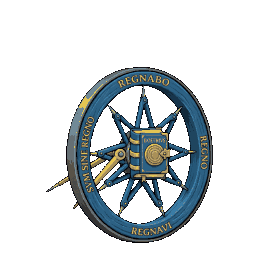
“This is my art, this the game I never cease to play. I turn the wheel that spins. I delight to see the high come down and the low ascend.”

Boethius, The Consolation of Philosophy II.2 — Lady Philosophy speaking in the voice of Fortune (trans. H. R. James, 1897, public domain).public domain
How it works in the game: the move The Wheel of Fortune
ExperienceArgument · power 60 · 100% accurate

In the gameFortune speaks in her own defence: the office, the money, the name — she lent them, and lending means taking back. Nothing she gave was ever the reader’s to lose.

Learned byConsolation (Lv 34)

“as the innermost of several circles revolving round the same centre approaches the simplicity of the midmost point… things are free from fate in proportion as they seek to come nearer to that central pivot.”

Boethius, The Consolation of Philosophy IV.6 (trans. H. R. James, 1897, public domain). (trimmed quote)public domain
How it works in the game: the move The Still Centre
RationalityArgument · power 75 · 100% accurate

In the gameProvidence is the fixed centre; fate is the rim, turning. A thing is bound by fate exactly as far as it stands out from the centre — and freed as it is drawn in toward God.

Learned byConsolation (Lv 36)

“Similarly the Father is truth, the Son is truth, and the Holy Spirit is truth; Father, Son, and Holy Spirit are not three truths, but one truth.”

Boethius, Utrum Pater et Filius et Spiritus Sanctus de divinitate substantialiter praedicentur (trans. H. F. Stewart & E. K. Rand, Loeb Classical Library 1918, public domain).public domain
How it works in the game: the move Not Three Truths
Theology ProperArgument · power 88 · 95% accurate

In the gameA test anyone can run. Say a thing of the Father, then of the Son, then of the Spirit; if it is still ONE when you have said it three times, it belongs to the substance. God, truth, goodness, justice, power — one each, not three. Only Father, Son and Spirit come out three, and those are relations, not substances.

Learned byBoethius’ Corpus (Lv 37)

“there are two necessities — one simple, as that men are necessarily mortal; the other conditioned, as that, if you know that someone is walking, he must necessarily be walking.”

Boethius, The Consolation of Philosophy V.6 (trans. H. R. James, 1897, public domain). (trimmed quote)public domain
How it works in the game: the move The Two Necessities
RationalityArgument · power 90 · 100% accurate

In the gameGod’s foreknowledge no more forces an act than the reader’s watching a man walk forces his walking. “He must be walking, since I see him” binds nothing — and neither does the divine sight.

Learned byConsolation (Lv 38)

“eternity is the possession of endless life whole and perfect at a single moment.”

Boethius, The Consolation of Philosophy V.6 (trans. H. R. James, 1897, public domain). The sentence Aquinas takes over whole.public domain
How it works in the game: the move An Eternal Present
Theology ProperArgument · power 95 · 95% accurate

In the gameGod is not stretched out along time, remembering and waiting as the reader does. He holds the whole of unending life at once, in one present. That is what the word “eternal” means.

Learned byConsolation (Lv 39)

Strong against
×2.5Summa Theologiaea book · why?

Aquinas defends Boethius’s definition of eternity against the charge that it only says what eternity lacks (Summa I, q.10, a.1).

“Since every fortune, welcome and unwelcome alike, has for its object the reward or trial of the good, and the punishing or amending of the bad, every fortune must be good, since it is either just or useful.”

Boethius, The Consolation of Philosophy IV.7 (trans. H. R. James, 1897, public domain).public domain
How it works in the game: the move Every Fortune Is Good
RationalityArgument · power 86 · 95% accurate

In the gameThe hard case put to Boethius in the cell: the wicked flourish, the just are broken. His answer is that no lot is simply bad — each one rewards, tests, corrects, or gives what is deserved, and so is either useful or just. A philosopher’s theodicy, not the whole of one; but a real answer.

Learned byBoethius’ Corpus (Lv 49)

Passages you can read in the game

Longer excerpts the Scriptorium holds on screen for a player to sit and read, word for word.

“This is my art, this the game I never cease to play. I turn the wheel that spins. I delight to see the high come down and the low ascend.”

Boethius, The Consolation of Philosophy II.2 — Lady Philosophy speaking in the voice of Fortune (trans. H. R. James, 1897, public domain).
from Consolation

“Then,” said she, “it is necessary to acknowledge that God is very happiness.” … “But we have also proved that God and true happiness are one and the same.”

Boethius, The Consolation of Philosophy III.10 (trans. H. R. James, 1897, public domain). (trimmed quote)
from Consolation

“as the innermost of several circles revolving round the same centre approaches the simplicity of the midmost point… things are free from fate in proportion as they seek to come nearer to that central pivot.”

Boethius, The Consolation of Philosophy IV.6 (trans. H. R. James, 1897, public domain). (trimmed quote)
from Consolation

“eternity is the possession of endless life whole and perfect at a single moment.”

Boethius, The Consolation of Philosophy V.6 (trans. H. R. James, 1897, public domain). The sentence Aquinas takes over whole.
from Consolation

Words Boethius’s books borrow from others

Moves these books can learn whose quotation comes from somebody else. The citation on each one names who actually said it.

“For in him we live, and move, and have our being. As some of your own poets have said.”

Acts 17:28 (WEB) — Paul at the Areopagus, quoting the Athenians’ own poets back to them.
How it works in the game: the move Affirm
Status

In the gamePick the part of the opponent’s case that is true and affirm it. That point can no longer be used against you, and the opponent’s Defend falls sharply. It deals no damage. Affirm something false and you have only agreed with an error.

Learned byDe Trinitate (Lv 28), Contra Eutychen (Lv 10), De Musica (Lv 19), Consolation (Lv 25), Boethius’ Corpus (Lv 25)

“He who pleads his cause first seems right; until another comes and questions him.”

Proverbs 18:17 (WEB).
How it works in the game: the move Question the Premise
RationalityType shift

In the gameChallenge the foundation of an argument before it can be pressed. Lowers the foe’s Contend.

Learned byDe Trinitate (Lv 30)

Who else was alive

Boethius against everyone else in the game.

A.D. 450A.D. 700A.D. 950A.D. 1200A.D. 1450A.D. 1700A.D. 1950
Solid bar = firm dates · faded = approximate51 authors sit outside this window
What Would Jesus Tech

Helping Christians use tech, find rest, and glorify God.

Listen
All Episodes
Explore Topics
Apple Podcasts
Spotify
About
The Hosts
Speakers
Books
Scripture
Scholar's Dream Game
Contact
Patreon
© 2026 What Would Jesus Tech · whatwouldjesustech.com·