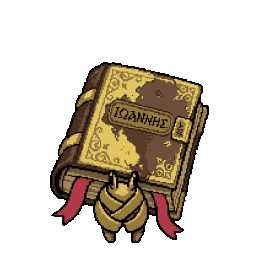
Exact Exposition
John of Damascus, An Exact Exposition of the Orthodox Faith
John of Damascus, monk of Mar Saba
The whole of doctrine, catalogued by a man who had watched his city change hands and kept writing.
- Catch rate
- 53 / 255
- Base research
- 180
- Stat total
- 306
Base stats
Every stat is a checkable fact about the actual book, not a designer's mood. Bars are drawn against the highest value any book reaches.
Why these numbers
The game's own explanation, as a reader sees it in the backpack.
A hundred chapters covering the whole of doctrine, handed on complete. Very little of this book has ever been in doubt, and none of it is lost.
It does not only assert the Trinity — it reasons toward it, from what God must be if he is living and rational at all. An argument that shows its working hits harder.
This became the standard doctrinal textbook of the Greek church and stayed so for centuries. A text that settled is a text that defends.
Enormously influential in the East and much less quoted in the West, so it is not always the first thing recalled.
Cited for this book
Written at Mar Saba, outside Jerusalem, under Muslim rule — John worked in the caliph’s administration before he became a monk. The last chapter of his heresy catalogue is the earliest substantial Christian account of Islam by a named author. On images this game does not follow him: Nicaea II settled that question in a direction the game’s own confession does not take, and says so where that council appears.
Development
A book develops as it is read — the fragment becomes the work, the work becomes the corpus.
Moves learned
By levelling up. A book that develops keeps what it knew and learns the rest on its new schedule.
| Lv | Move | Type | Cat. | Pwr | Acc | PP |
|---|---|---|---|---|---|---|
| 1 | Created or Uncreated | Natural Theology | Argument | 70 | 100% | 15 |
| 1 | Random Verse | Bible | Argument | 10 | 100% | 30 |
| 34 | Chapter… | Bible | Scripture | — | — | 12 |
| 36 | The Word and the Spirit | Theology Proper | Argument | 66 | 100% | 15 |
| 39 | God Is Not Wordless | Theology Proper | Argument | 72 | 100% | 10 |
| 42 | The God of Matter | Christology | Argument | 74 | 95% | 10 |
| 45 | Two Perfect Natures | Christology | Argument | 80 | 100% | 10 |
Read it: Not Wordless
The passages the Scriptorium holds on screen, word for word from a public-domain translation. Written in Greek.
“All things, that exist, are either created or uncreated. If, then, things are created, it follows that they are also wholly mutable.”
John of Damascus, An Exact Exposition of the Orthodox Faith 1.3 (trans. Salmond, NPNF² 9, public domain).
“But things that are created must be the work of some maker, and the maker cannot have been created. For if he had been created, he also must surely have been created by some one, and so on till we arrive at something uncreated.”
John of Damascus, An Exact Exposition of the Orthodox Faith 1.3 (trans. Salmond, NPNF² 9, public domain).
“So then this one and only God is not Wordless. And possessing the Word, He will have it not as without a subsistence, nor as having had a beginning, nor as destined to cease to be.”
John of Damascus, An Exact Exposition of the Orthodox Faith 1.6 (trans. Salmond, NPNF² 9, public domain).
“For there never was a time when God was not Word: but He ever possesses His own Word, begotten of Himself.”
John of Damascus, An Exact Exposition of the Orthodox Faith 1.6 (trans. Salmond, NPNF² 9, public domain). The sentence answers Arius in Arius’ own words — “there was when he was not.”
Written at Mar Saba, outside Jerusalem, under Muslim rule — John worked in the caliph’s administration before he became a monk. The last chapter of his heresy catalogue is the earliest substantial Christian account of Islam by a named author.
The argument runs from creation up to something uncreated, then from “God is not without His Word” straight into Nicaea. On images this game does not follow him, and says so where Nicaea II appears.