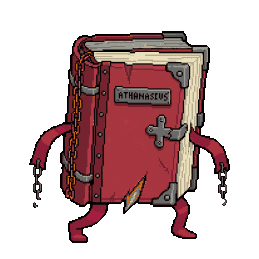
← All books
On the Incarnation

On the Incarnation

Athanasius, Contra Gentes — De Incarnatione

Athanasius of Alexandria

More about Athanasius →

Two books against the heathen, written young. He was still defending them forty-five years and five exiles later.

Catch rate
55 / 255
Base research
196
Stat total
344

Base stats

Every stat is a checkable fact about the actual book, not a designer's mood. Bars are drawn against the highest value any book reaches.

Stamina84
Contend96
Defend76
Popularity88
Total344

Why these numbers

The game's own explanation, as a reader sees it in the backpack.

Stamina 84

High. Two parts and about ninety chapters: a case against the idols, an argument that the soul can know God, and then the Incarnation. Jerome listed the two parts as one book, and the manuscripts carry them that way.

Contend 96

Athanasius went into exile five times across forty-five years rather than sign a word he thought was wrong, and the creed the whole church says on Sundays is the one he defended. Very high Contend.

Defend 76

A well-attested Greek text in two recensions that agree on everything that matters.

Popularity 88

The second half is the one work of patristic theology most modern readers have actually finished. The first half they have mostly not heard of.

Cited for this book

Athanasius wrote this in his twenties, as a deacon, before Arius became an issue. The first half argues pagans out of idol worship. The second asks what God could do about a creation falling apart, and answers that only the Maker could remake it. He spent the next forty-five years defending that answer.

Development

A book develops as it is read — the fragment becomes the work, the work becomes the corpus.

Moves learned

By levelling up. A book that develops keeps what it knew and learns the rest on its new schedule.

LvMoveTypeCat.PwrAccPP
1Only the Maker RemakesChristologyArgument78100%10
1Random VerseBibleArgument10100%30
8The Soul Travels Without the BodyAnthropologyArgument54100%20
12The Sculptor ForgetsRationalityArgument58100%20
13Affirm—Status——1
16A God for Every VillageRationalityArgument62100%15
20Chapter…BibleScripture——12
24Word Made FleshChristologyArgument70100%6
28Rule of FaithChristologyArgument55100%15
32Two Gods Cancel OutRationalityArgument66100%10
36No Substance in EvilTheology ProperArgument68100%10
50Speak GreekHistoryStatus—100%5

The quotes behind its moves

How to read these. In Scholar’s Dream, books argue with each other. Each thing a book can do in a debate is a move, and most moves carry a real quotation — the words the book puts on the table when it uses that move.

Strong against lists the opposing books and arguments a move was written to answer. Used against one of them, it hits much harder than usual: ×2 means twice the normal force, ×4 four times. It is the game’s way of saying: this is the sentence that answers that argument. Open an entry to read why.

“For being Word of the Father, and above all, He alone of natural fitness was both able to recreate everything, and worthy to suffer on behalf of all and to be ambassador for all with the Father.”

Athanasius, On the Incarnation 7.5 (trans. Archibald Robertson, NPNF² 4, public domain).public domain

Only the Maker Remakes

ChristologyArgument · power 78 · 100% accurate

In the gameA creature cannot re-create a creation — it can only be part of one. So whoever remade the world was not made. Athanasius spent forty-five years and five exiles refusing to move off this.

Strong against
×2Changeable by Naturean argument · why?

A changeable creature could not remake creation; it would need saving itself. The Son who saves the world is its unchanging Maker.

×2Exalted Creaturean argument · why?

Only the one who made the world can remake it. If the Son remakes creation, he cannot be the first of the creatures. He is their Maker.

×2God by Gracean argument · why?

A title cannot remake the world. Only the Creator can do that, so the Son must be God by nature, not by courtesy.

×2The Thaliaan argument · why?

If the Son had a beginning, he is a creature, and a creature cannot remake creation. The one who saves the world must be the one who made it, so there was never a time when he was not.

“When the body is quiet, and at rest and asleep, man moves inwardly, and beholds what is outside himself, travelling to other countries, walking about, meeting his acquaintances… But to what can this be due save to the rational soul?”

Athanasius, Contra Gentes 31 (trans. Robertson, NPNF² 4, public domain).public domain

The Soul Travels Without the Body

AnthropologyArgument · power 54 · 100% accurate

In the gameAsleep, the body lies still — and the mind walks other roads and meets other faces. Something in us is not the body. May steady the reader’s own Defend.

“The image-maker, as though forgetting the work he has done himself, prays to his own productions, and calls gods what just before he was paring and chipping… it is not the material that has adorned the art, but the art that has adorned and deified the material.”

Athanasius, Contra Gentes 13 (trans. Robertson, NPNF² 4, public domain). He is deliberately echoing Isaiah 44:9–20.public domain

The Sculptor Forgets

RationalityArgument · power 58 · 100% accurate

In the gameA little while ago it was a block he was cutting to shape. Now he kneels to it, having somehow forgotten whose hands did the shaping.

“For in him we live, and move, and have our being. As some of your own poets have said.”

Acts 17:28 (WEB) — Paul at the Areopagus, quoting the Athenians’ own poets back to them.

Affirm

Status

In the gamePick the part of the opponent’s case that is true and affirm it. That point can no longer be used against you, and the opponent’s Defend falls sharply. It deals no damage. Affirm something false and you have only agreed with an error.

“Every city and village, not knowing the gods of its neighbours, prefers its own, and deems that these alone are gods… all the nations that are infatuated with idols have different opinions and religions, and consistency is not to be met with in any one case.”

Athanasius, Contra Gentes 23 (trans. Robertson, NPNF² 4, public domain).public domain

A God for Every Village

RationalityArgument · power 62 · 100% accurate

In the gameEgypt does not know the gods of Phoenicia, and the next village worships what this one calls unclean. If they cannot agree among themselves, the agreement is not what makes any of them true.

Strong against
×2The True Word: On the Godsan argument · why?

Athanasius turned the argument around. It is the village gods that are local: every town worships its own. The God who made everything can come to any village he chooses.

“the renewal of creation has been the work of the self-same Word that made it at the beginning. For it will appear not inconsonant for the Father to have wrought its salvation in Him by Whose means He made it.”

Athanasius, On the Incarnation 1.4 (trans. Archibald Robertson, NPNF² 4, public domain).public domain

Word Made Flesh

ChristologyArgument · power 70 · 100% accurate

In the gameFrom Athanasius: only the Creator can recreate.

Strong against
×4One Nature After the Unionan argument · why?

It holds the flesh in place — which is the one thing his union cannot do.

×4The Ugly Broad Ditchan argument · why?

Lessing’s ditch says history can never carry necessary truth. The claim on the table is that it did, once, on purpose — the Word made flesh, a fact about a Tuesday.

×3The Many Faiths, One Realan argument · why?

Hick says the faiths are level roads to one summit. Athanasius answers with a fact and not a view: God himself became a man. That cannot be one road among several, because it is not a road at all. It is an arrival.

×2Changeable by Naturean argument · why?

The Word who became flesh is the Word who made the world. He was truly tempted, but he was never a creature who might have gone the other way.

×2Devout Man Onlyan argument · why?

A devout man can teach, but he cannot remake the world. The Word who made creation became flesh to renew it, and that is why he is worshipped.

×2Exalted Creaturean argument · why?

Athanasius’ answer: only the one who made the world can remake it. A creature, however high, cannot save creation, because it is part of creation.

×2God by Gracean argument · why?

Athanasius says the Word who renews creation is the same Word who made it. That is who the Son is, not a title he was lent.

×2The Thaliaan argument · why?

The Word who became flesh is the Word through whom everything was made, time included. The one who made time did not begin within it.

×2The True Word: On the Godsan argument · why?

The Word who came down is the Word who made the world. Coming into his own creation does not change the Creator.

×2Thirty Aeonsan argument · why?

The thirty levels exist to keep God away from matter. John 1 answers that he came down all of them himself — the Word, made flesh.

“The Church, though dispersed … the whole world… has received from the apostles and their disciples this faith… carefully preserves it, as if dwelling in but a single house.”

Irenaeus, Against Heresies 1.10.1–2 (trans. Roberts & Rambaut, ANF 1, public domain; condensed).public domain

Rule of Faith

ChristologyArgument · power 55 · 100% accurate

In the gameOne public tradition, handed down openly in all the churches.

Strong against
×4Gos. Judasa book · why?

And this book is BUILT on that error — it has nowhere left to stand once the rule is read out.

×4Gos. Thomasa book · why?

And this book is BUILT on that error — it has nowhere left to stand once the rule is read out.

×2"That’s Three Gods"an argument · why?

Irenaeus points to the one faith held by the churches everywhere: one God the Father, one Lord Jesus Christ, and the Holy Spirit. The church has always named three and counted one God.

×2Hidden Sparkan argument · why?

Irenaeus shows the church has not grown through sharing secrets but by bearing witness (publicly!) to the truth, from Germany to Egypt.

×2Letter to Floraan argument · why?

Ptolemy wrote it privately, to one woman. Irenaeus’ test is a faith said aloud in every church, for anyone to compare.

×2The Traitor’s Handsan argument · why?

Irenaeus points to the one faith held by all the churches together. The Donatists kept a pure church in one province, but the true church is spread through the whole world.

×2Thirty Aeonsan argument · why?

Irenaeus’ complaint was that no two Valentinian teachers described the aeons the same way. He compared their disagreements against the shared and consistent testimony of the church — the Rule of Faith.

“For it is impossible for them to exist together, because they are mutually destructive.”

Athanasius, Contra Gentes 6–7 (trans. Robertson, NPNF² 4, public domain) — on the dualists’ two contrary principles. He also presses the "third nature dividing them" horn.public domain

Two Gods Cancel Out

RationalityArgument · power 66 · 100% accurate

In the gameSet a good god and an evil god side by side as equals and each one’s existence defeats the other’s will. Neither ends up almighty, and the whole arrangement falls over.

Strong against
×2The Two Kingdomsan argument · why?

Athanasius’ logic: two equal gods, one good and one evil, would each block the other. Neither would be almighty, so neither would be God.

“Good is, while evil is not; by what is, then, I mean what is good, inasmuch as it has its pattern in God Who is. But by what is not I mean what is evil, in so far as it consists in a false imagination in the thoughts of men.”

Athanasius, Contra Gentes 4 (trans. Archibald Robertson, NPNF² 4, public domain); pressed again at ch. 7.public domain

No Substance in Evil

Theology ProperArgument · power 68 · 100% accurate

In the gameGood is, because it has its pattern in God, who is. Evil is not — it is what men invent when they stop looking at what is. Athanasius said it decades before Augustine made it famous.

Strong against
×2The Two Kingdomsan argument · why?

Athanasius wrote that good truly exists, because it comes from God, and evil does not exist in the same way. Evil is a turning away from what is, not a second thing that was always there.

Read it: That We Might Be Made God

The passages the Scriptorium holds on screen, word for word from a public-domain translation. Written in Koine Greek.

“In the beginning wickedness did not exist. Nor indeed does it exist even now in those who are holy, nor does it in any way belong to their nature.”

Athanasius, Against the Heathen 2 (trans. Robertson, NPNF² 4, public domain, lightly modernized).

“The way of truth will aim at reaching the real and true God. But for its knowledge and accurate comprehension, there is need of none other save of ourselves.”

Athanasius, Against the Heathen 30 (trans. Robertson, NPNF² 4, public domain, lightly modernized).

“For being Word of the Father, and above all, He alone of natural fitness was both able to recreate everything, and worthy to suffer on behalf of all and to be ambassador for all with the Father.”

Athanasius, On the Incarnation 7 (trans. Robertson, NPNF² 4, public domain).

“For He was made man that we might be made God; and He manifested Himself by a body that we might receive the idea of the unseen Father; and He endured the insolence of men that we might inherit immortality.”

Athanasius, On the Incarnation 54 (trans. Robertson, NPNF² 4, public domain).
Notes

One book in two halves. Jerome catalogues them as a single work, and the NPNF editor says outright that the two titles are a modern convenience.

The order is the argument. The first half clears the ground — idolatry is something men invented, and evil has no nature of its own to stand on. Only then does the second half build.

Written young, and it shows: no bishop yet, no exiles yet, none of the forty years of fighting that came after.

Read the last line again and watch the direction. Made God, not made a god. Athanasius means a share, given, of what belongs to God by nature — and he has just spent fifty sections arguing that only God could hand it over.

What Would Jesus Tech

Helping Christians use tech, find rest, and glorify God.

Listen
All Episodes
Explore Topics
Apple Podcasts
Spotify
About
The Hosts
Speakers
Books
Scripture
Scholar's Dream Game
Contact
Patreon
© 2026 What Would Jesus Tech · whatwouldjesustech.com·