← All books
On Holy Images

On Holy Images

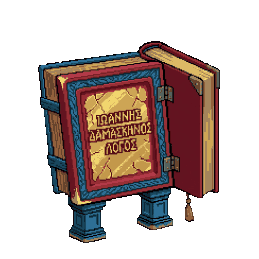
John of Damascus, Apologia Against Those Who Decry Holy Images

John of Damascus, monk of Mar Saba

More about John of Damascus →

Written from outside the empire, by the one man the emperor could not silence.

Catch rate
53 / 255
Base research
164
Stat total
256

Base stats

Every stat is a checkable fact about the actual book, not a designer's mood. Bars are drawn against the highest value any book reaches.

Stamina66
Contend72
Defend66
Popularity52
Total256

Why these numbers

The game's own explanation, as a reader sees it in the backpack.

Contend 72

John does not argue about art. He argues about the Incarnation, and then asks what follows — which is why the case is hard to answer at the level it was made.

Defend 66

Three treatises, transmitted entire, and a council behind them within sixty years of his death.

Popularity 52

Read in the East for twelve centuries and barely opened in the West.

Cited for this book

Emperor Leo III began removing images from churches around 726. John of Damascus answered him from a monastery in the Judaean desert, outside the emperor’s reach. His argument starts from the Incarnation: if matter cannot carry holiness, what does it mean that God took flesh? The council of Nicaea II agreed with him in 787. Reformed Christians do not, because of the second commandment.

Development

A book develops as it is read — the fragment becomes the work, the work becomes the corpus.

Moves learned

By levelling up. A book that develops keeps what it knew and learns the rest on its new schedule.

LvMoveTypeCat.PwrAccPP
1The Image of the InvisibleChristologyArgument84100%10
1Random VerseBibleArgument10100%30
10Affirm—Status——1
34Chapter…BibleScripture——12
38A Book to the UnletteredEcclesiologyArgument70100%15
42The God of MatterChristologyArgument7495%10
46Stronger Than KingsFaithArgument78100%10
50Speak GreekHistoryStatus—100%5

The quotes behind its moves

How to read these. In Scholar’s Dream, books argue with each other. Each thing a book can do in a debate is a move, and most moves carry a real quotation — the words the book puts on the table when it uses that move.

Strong against lists the opposing books and arguments a move was written to answer. Used against one of them, it hits much harder than usual: ×2 means twice the normal force, ×4 four times. It is the game’s way of saying: this is the sentence that answers that argument. Open an entry to read why.

“Therefore I venture to draw an image of the invisible God, not as invisible, but as having become visible for our sakes through flesh and blood. I do not draw an image of the immortal Godhead. I paint the visible flesh of God.”

John of Damascus, On Holy Images 1 (trans. Mary H. Allies, 1898, public domain).public domain

The Image of the Invisible

ChristologyArgument · power 84 · 100% accurate

In the gameJohn of Damascus argues from the Incarnation. He is not painting God; he is painting the flesh God took. Whether that answers the second commandment is the real question, and this is his case at its strongest.

“For in him we live, and move, and have our being. As some of your own poets have said.”

Acts 17:28 (WEB) — Paul at the Areopagus, quoting the Athenians’ own poets back to them.

Affirm

Status

In the gamePick the part of the opponent’s case that is true and affirm it. That point can no longer be used against you, and the opponent’s Defend falls sharply. It deals no damage. Affirm something false and you have only agreed with an error.

“The image is a memorial, just what words are to a listening ear. What a book is to the literate, that an image is to the illiterate. The image speaks to the sight as words to the ear; it brings us understanding.”

John of Damascus, On Holy Images 1 (trans. Mary H. Allies, 1898, public domain).public domain

A Book to the Unlettered

EcclesiologyArgument · power 70 · 100% accurate

In the gameThe pastoral half of the argument, and the half that actually persuaded most of Christendom: most people in an eighth-century church could not read a word of the book being preached from.

“I do not worship matter, I worship the God of matter, who became matter for my sake, and deigned to inhabit matter, who worked out my salvation through matter.”

John of Damascus, On Holy Images 1.16 (trans. Mary H. Allies, 1898, public domain). The modern phrasing “I worship the Creator of matter” is a different, later rendering.public domain

The God of Matter

ChristologyArgument · power 74 · 95% accurate

In the gameJohn of Damascus wrote this to an emperor who was destroying images. His argument is that God took a body, and a faith embarrassed by matter has not understood what happened.

“Fear, then, compelled me to speak; the truth was stronger than the majesty of kings.”

John of Damascus, On Holy Images 1 (trans. Mary H. Allies, 1898, public domain).public domain

Stronger Than Kings

FaithArgument · power 78 · 100% accurate

In the gameEmperor Leo III was pulling down images in Constantinople. John of Damascus could answer him freely because the emperor could not reach him: John lived at Mar Saba, under a Muslim caliph.

What Would Jesus Tech

Helping Christians use tech, find rest, and glorify God.

Listen
All Episodes
Explore Topics
Apple Podcasts
Spotify
About
The Hosts
Speakers
Books
Scripture
Scholar's Dream Game
Contact
Patreon
© 2026 What Would Jesus Tech · whatwouldjesustech.com·