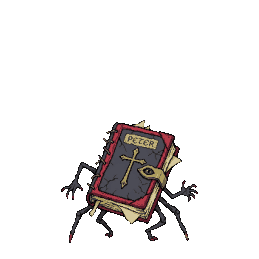
The passages the Scriptorium holds on screen, word for word from a public-domain translation. Written in Koine Greek.
“And they clothed him with purple, and set him on the seat of judgment, saying, Judge righteously, O king of Israel. And one of them brought a crown of thorns and put it on the head of the Lord… and some scourged him, saying, With this honour let us honour the Son of God.”
Gospel of Peter 3 (trans. Armitage Robinson, ANF 9, public domain).
“And they brought two malefactors, and they crucified the Lord between them. But he held his peace, as though having no pain.”
Gospel of Peter 4 (trans. Armitage Robinson, ANF 9, public domain).
“And the Lord cried out, saying, My power, my power, thou hast forsaken me. And when he had said it he was taken up.”
Gospel of Peter 5 (trans. Armitage Robinson, ANF 9, public domain).
“Again they see three men come forth from the tomb, and two of them supporting one, and a cross following them: and of the two the head reached unto the heaven, but the head of him that was led by them overpassed the heavens.”
Gospel of Peter 10 (trans. Armitage Robinson, ANF 9, public domain).
“And they heard a voice from the heavens, saying, Thou hast preached to them that sleep. And a response was heard from the cross, Yea.”
Gospel of Peter 10 (trans. Armitage Robinson, ANF 9, public domain).
“Pilate answered and said, I am pure from the blood of the Son of God: but it was ye who determined this.”
Gospel of Peter 11 (trans. Armitage Robinson, ANF 9, public domain).
Notes
Go back to chapter 4 and read the last six words again: "as though having no pain." Everything wrong with this book is in that clause. A crucifixion is happening and the writer wants you to know it did not really reach him.
Then the cry. Matthew and Mark both keep the Aramaic — Eloi, Eloi, lema sabachthani — quoting Psalm 22: "My God, my God, WHY have you forsaken me." This book quietly swaps God for "power," drops the "why," and adds "he was taken up." Not a death. A departure.
That is docetism doing its work in a single misquoted psalm — the exact error Ignatius spent a whole letter on, and which you may be carrying the answer to right now.
Chapter 10 shows the other failure mode: not subtlety but excess. Two figures whose heads reach the sky, a third higher still, and a cross walking out of the tomb behind them and answering a voice. The canonical resurrection accounts are, by comparison, almost embarrassed — women, confusion, and nobody who saw the moment itself.
Watch Pilate too. Herod condemns Jesus here and Pilate washes his hands of the Son of God. The blame slides steadily off Rome and onto the Jews — a trajectory that gets worse the later the text.
And this book has the best-documented rejection of any apocryphon. Serapion, bishop of Antioch around A.D. 190–203, allowed a congregation to use it, read it properly afterwards, and withdrew permission for containing Docetic corruptions. A bishop changing his mind in public, in writing, and Eusebius kept the letter.
One honest caution: the surviving Akhmim fragment was dug from a monk’s grave in 1886, and the manuscript itself is eighth-century or later. Whether it is even the same book Serapion read is genuinely argued. That is why this book’s Defend is so weak.