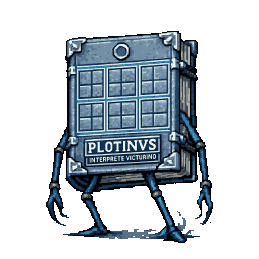

Enneads
Plotinus, Enneads (in Victorinus’ Latin)
Plotinus; arranged by Porphyry; translated by Marius Victorinus
Six sets of nine treatises on the One. Arranged by Porphyry — yes, that Porphyry.
- Catch rate
- Not found in the wild
- Base research
- 200
- Stat total
- 282
Base stats
Every stat is a checkable fact about the actual book, not a designer's mood. Bars are drawn against the highest value any book reaches.
Why these numbers
The game's own explanation, as a reader sees it in the backpack.
Fifty-four treatises, arranged into six sets of nine by Porphyry, and all of them survive. Very high Stamina.
The book that taught the Latin West how to think about a God who is not made of anything. That is a large amount of force for a book with no Scripture in it.
Philosophers read it carefully; almost no one else opens it. It usually speaks second.
Cited for this book
Marius Victorinus translated Plotinus into Latin, and Augustine read him in that Latin. It gave him a way to think about God that was not made of stuff — which is what finally let him stop picturing God as an enormous luminous body. Victorinus’ own late conversion is told in Confessions 8.2, and it is the story that got Augustine as far as the garden wall.
Development
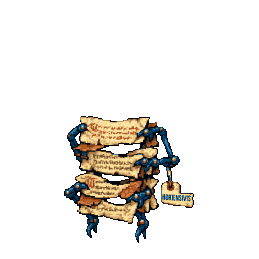
A book develops as it is read — the fragment becomes the work, the work becomes the corpus.
Moves learned
By levelling up. A book that develops keeps what it knew and learns the rest on its new schedule.
| Lv | Move | Type | Cat. | Pwr | Acc | PP |
|---|---|---|---|---|---|---|
| 22 | The One Beyond Being | Natural Theology | Argument | 70 | 95% | 10 |
| 26 | Question the Premise | Rationality | Type shift | — | — | 10 |
| 30 | Take Up and Read | Bible | Argument | 80 | 100% | 5 |
Read it: Honour Then Yourself
The passages the Scriptorium holds on screen, word for word from a public-domain translation. Written in Koine Greek — Augustine read it in Latin.
“If, then, it is the presence of soul that brings worth, how can a man slight himself and run after other things? You honour the Soul elsewhere; honour then yourself.”
Plotinus, Enneads 5.1.2 (trans. MacKenna & Page, public domain).
“But over this divine, there is still a diviner: grasp the upward neighbour of the soul, its prior and source. Soul, for all the worth we have shown to belong to it, is yet a secondary, an image of the Intellectual-Principle.”
Plotinus, Enneads 5.1.3 (trans. MacKenna & Page, public domain).
Not a Christian book, and it is not pretending to be. Plotinus taught at Rome in the 250s and never mentions Christ except to attack people he calls Gnostics.
What it did for Augustine was purely negative, and enormous. He had been unable to think of God as anything but a very large bright thing spread out in space. These books gave him a way to think of something real that is not extended at all.
So read the ladder and see where it goes. Body, then soul, then the Intellectual-Principle, then the One beyond even that — up and up, away from matter, by climbing.
And that is exactly where it stops. Augustine’s own verdict is that he found in these books that the Word was God, and did not find that the Word was made flesh. The ladder goes up. It never comes down to fetch anybody.