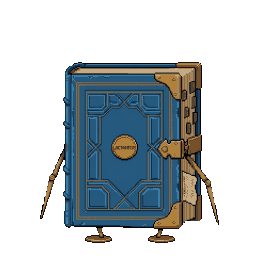
Divine Institutes
Lactantius, Divinae Institutiones
Lactantius
The best Latin prose any Christian wrote that century, and its author knew it.
- Catch rate
- 70 / 255
- Base research
- 170
- Stat total
- 258
Base stats
Every stat is a checkable fact about the actual book, not a designer's mood. Bars are drawn against the highest value any book reaches.
Why these numbers
The game's own explanation, as a reader sees it in the backpack.
Seven books, entire — the first attempt anybody made at a systematic defence of the faith in Latin.
Lactantius writes the best Latin prose of any Christian of his century and is not the best theologian of any decade of it. Fine Contend, and not more than fine.
Read steadily ever since, largely by people who came for the style.
Cited for this book
They called him the Christian Cicero, and he had earned it — Constantine hired him to tutor his son. He also watched the Great Persecution from inside Diocletian’s own capital and wrote down who died and how. And he quotes Cicero constantly, including a lost book of his that survives nowhere else in one piece.
Moves learned
By levelling up. A book that develops keeps what it knew and learns the rest on its new schedule.
| Lv | Move | Type | Cat. | Pwr | Acc | PP |
|---|---|---|---|---|---|---|
| 1 | Wisdom and Religion | Rationality | Argument | 66 | 100% | 15 |
| 1 | Random Verse | Bible | Argument | 10 | 100% | 30 |
| 9 | Their Own Poets | Rationality | Argument | 65 | 100% | 10 |
| 16 | One Ruler | Natural Theology | Argument | 55 | 100% | 20 |
| 20 | Chapter… | Bible | Scripture | — | — | 12 |
| 24 | Steelman | Rationality | Type shift | — | — | 10 |
| 28 | Martyr’s Resolve | Ethics | Argument | 50 | 100% | 15 |
| 36 | Sarcasm | Rationality | Argument | 60 | 95% | 15 |
Read it: Wisdom and Religion, Not Separated
The passages the Scriptorium holds on screen, word for word from a public-domain translation. Written in Latin.
“I have believed that these errors should be encountered, that both the learned may be directed to true wisdom, and the unlearned to true religion.”
Lactantius, Divine Institutes, preface (trans. Fletcher, ANF 7, public domain, lightly modernized).
“…in this government of the affairs of nature, unless there shall be one to whom the care of the whole is referred, all things will be dissolved and fall to decay.”
Lactantius, Divine Institutes 1.3 (trans. Fletcher, ANF 7, public domain, lightly modernized).
“Thus philosophy, inasmuch as it does not possess true religion, that is, the highest piety, is not true wisdom.”
Lactantius, Divine Institutes 4.3, the chapter he headed “Wisdom and Religion Cannot Be Separated” (trans. Fletcher, ANF 7, public domain).
“For when the people see that men are lacerated by various kinds of tortures, and that they retain their patience unsubdued while the executioners are wearied…”
Lactantius, Divine Institutes 5.13 (trans. Fletcher, ANF 7, public domain, lightly modernized).
“Justice by its own nature has a certain appearance of folly.”
Lactantius, Divine Institutes 5.15 (trans. Fletcher, ANF 7, public domain).
Seven books, written while the Great Persecution was still running, by a professor of rhetoric who had lost his chair for being a Christian and wrote the first systematic Latin defence of the faith anyway.
His thesis fits in one sentence: pagan religion has no ethics and pagan philosophy has no piety, so neither of them is wisdom. Only the two together, which he calls true religion.
Note who he is writing for — the learned and the unlearned, named separately in the same sentence of the preface. He is doing two jobs at once and says so.
He is also the man who preserved a line of Cicero’s lost Hortensius by arguing with it. If you are carrying that book, this is one of the two men you have to thank for it existing at all.