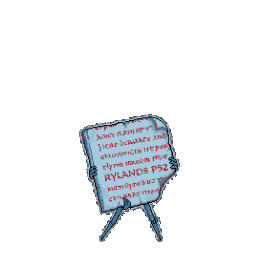
The passages the Scriptorium holds on screen, word for word from a public-domain translation. Written in Koine Greek.
Pilate told them, “Take him yourselves and pass judgment on him according to your own law!” The Jewish leaders replied, “We cannot legally put anyone to death.” (This happened to fulfill the word Jesus had spoken when he indicated what kind of death he was going to die.)
John 18:31–32 (NET) — the recto of Papyrus 52.
So Pilate went back into the governor’s residence, summoned Jesus, and asked him, “Are you the king of the Jews?”
John 18:33 (NET) — the recto of Papyrus 52.
Then Pilate said, “So you are a king!” Jesus replied, “You say that I am a king. For this reason I was born, and for this reason I came into the world—to testify to the truth. Everyone who belongs to the truth listens to my voice.”
John 18:37 (NET) — the verso of Papyrus 52.
Pilate asked, “What is truth?”
John 18:38 (NET) — the verso of Papyrus 52.
Notes
That is all of it. A scrap about nine centimetres by six, in the John Rylands Library at Manchester — P. Ryl. Gr. 457, catalogued as 𝔓52. A few verses on the front, a few on the back, and torn away on every side.
It is a leaf from a CODEX, not a scroll — written on both sides. That detail is worth as much as the date: Christians were binding books when the rest of the world was still unrolling them.
On the dating, be careful. The traditional c. A.D. 125 rests on comparing handwriting, and palaeography of literary hands carries a range measured in decades, not years. That P52 is "the earliest New Testament manuscript" is contested, not settled.
And be careful about what it proves. Even on the earliest date, it shows John circulating in Egypt, in codex form, early. It does not by itself date when John was written. The honest smaller claim is the one that holds.
What is NOT in doubt is the text. The words on the scrap match John. Certainty about the wording and certainty about the date are two different things, and this fragment has plenty of the first.
Of all the pages that could have survived: Pilate asking what truth is, with the answer standing in front of him.